The Universal Grammar
[count] [register] operator [count] motion
Vim is a tiny language: verbs (operators) compose with nouns (motions and text objects). Once you see the grammar, every key falls into place.
Almost every command in Vim follows one shape:
[count] ["reg] operator [count] motionRead it as a sentence: do this thing, optionally to register r, this many times, to this stretch of text. (Registers are named clipboards — the "a prefix means "into register a"; the full treatment is in Registers.) Concrete examples:
| Command | Reads as |
|---|---|
| dw | Delete one word forward |
| 3dw | Delete three words forward |
| d3w | Delete three words forward (counts multiply, but here one of them is 1) |
| ciw | Change the inner word the cursor is on |
| y$ | Yank from cursor to end of line |
| >ip | Indent inner paragraph |
| "ayy | Yank this line into register a |
| gUiw | Uppercase the inner word |
The verbs (operators)
| Operator | Meaning |
|---|---|
| d | Delete (cut) |
| c | Change (delete then enter insert mode) |
| y | Yank (copy) |
| > | Indent right |
| < | Indent left |
| = | Auto-indent / format |
| gU | Uppercase |
| gu | Lowercase |
| g~ | Toggle case |
| gq | Format (line-wrap) |
| ! | Filter through external command |
The nouns (motions and text objects)
Anything that moves the cursor in normal mode is a motion. After an operator, the same motion describes the range the operator acts on. So w alone moves the cursor a word forward; dw deletes the same span.
| Noun kind | Examples |
|---|---|
| Word / WORD | w, b, e, W, B, E |
| Line | 0, ^, $, _, g_ |
| File | gg, G, {n}G |
| Find on line | f{c}, F{c}, t{c}, T{c}, ;, , |
| Search | /{pattern}, ?{pattern}, n, N, *, # |
| Sentence / paragraph | (, ), {, } |
| Bracket match | % |
| Inner / around text object | iw, aw, i", a(, ip, at |
Text objects (the i / a rows) are nouns that describe structure rather than a path: i means the inner contents (e.g. iw = the word the cursor is in), a means the object plus its delimiters (e.g. a" = a quoted string including the quotes). The full treatment is in Text Objects — for now, treat them as nouns like any other.
Worked example — operator + motion = sentence
The grammar in three keystrokes.
q.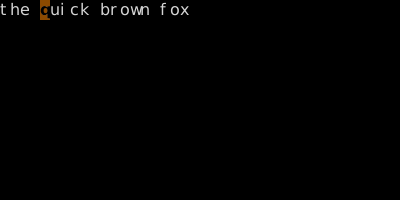
normal mode. We'll run dw: the delete operator with the word motion.
dw — quick deleted.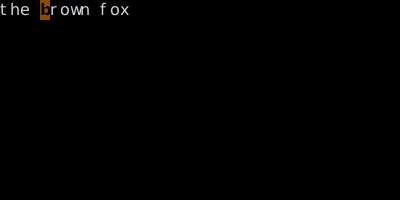
Operator d (verb) plus motion w (noun). The same grammar applies for any operator+motion pair.
gUw — BROWN uppercased.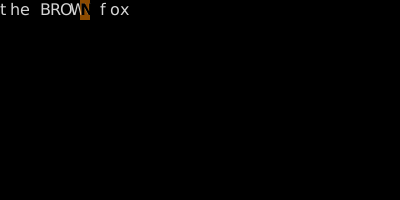
Swap the operator for gU (uppercase), keep motion w. Free upgrade — every motion works with every operator.
See also: The Vim Grammar, Delete, Change, Yank and Put, Inner Word vs Around Word